The Origin Story: Batteries, Brains, and a Name Change
Lucid began life as Atieva in 2007, founded to build advanced EV batteries and powertrains rather than complete cars. That focus on the electrical heart of the vehicle shaped the company’s DNA: efficiency, high energy density, and an engineering-first approach. In 2016, the company rebranded to Lucid Motors and shifted explicitly toward building its own luxury electric sedan-the Lucid Air-a move that set the stage for everything that followed.
Peter Rawlinson, a former Tesla Model S chief engineer who joined Atieva as CTO, became Lucid’s public face in the late 2010s. His background-and the company’s deep battery and powertrain experience-helped position Lucid as more than another EV maker; it aimed to push range and efficiency limits while delivering a premium user experience.
A Technology-First Product: Why the Air Matters
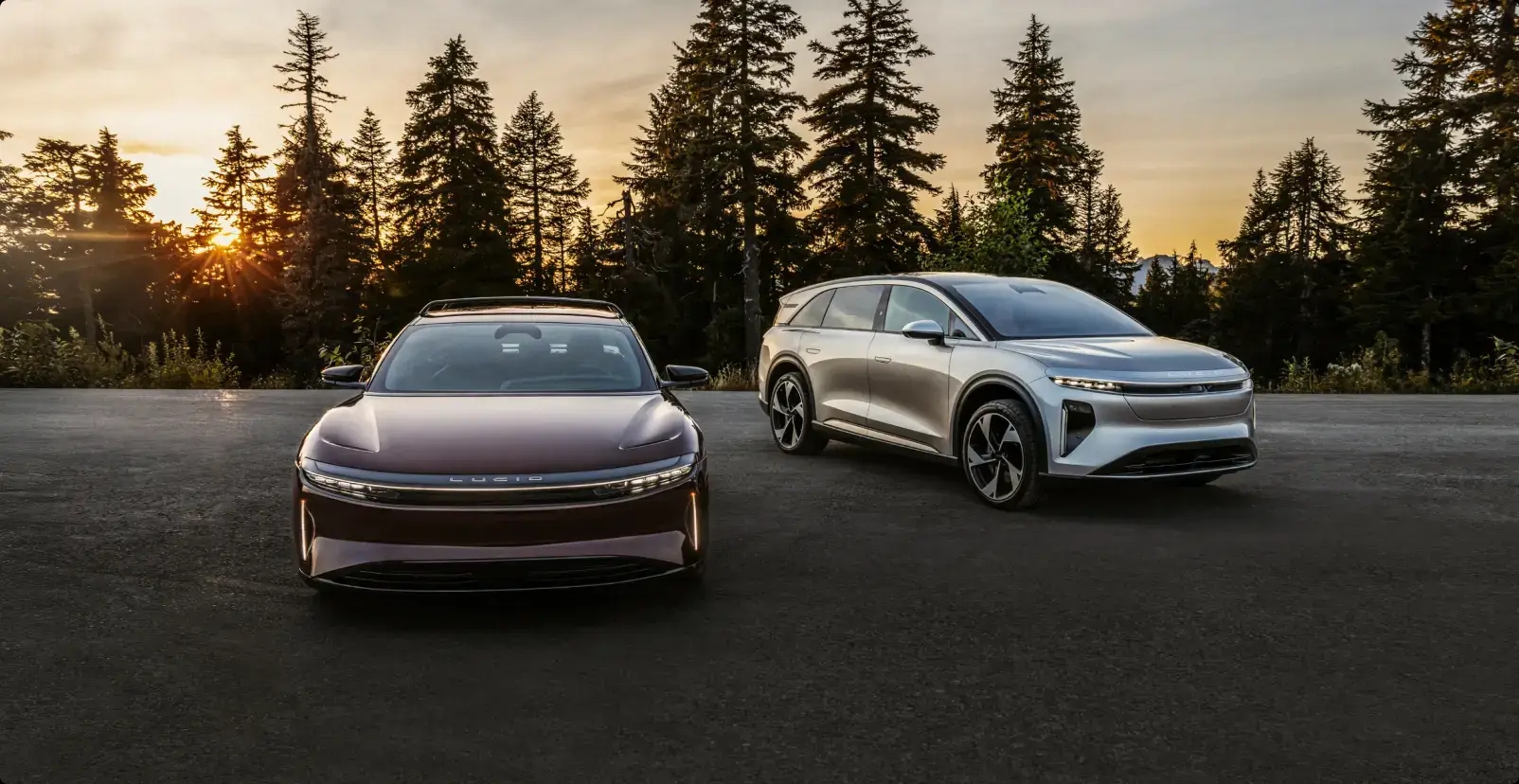
Rather than starting from a styling brief, Lucid designed the Air around a core engineering objective: maximum range and efficiency without sacrificing performance or luxury. That philosophy led to several distinctive technical choices:
- A highly efficient electric powertrain and motor architecture, featuring a class-leading 900V+ ultra-high voltage architecture that supports ultra-fast charging (up to 200 miles in about 12 minutes) and minimizes thermal losses.
- Compact packaging that freed interior space (the “skateboard” battery architecture gives a low center of gravity and generous cabin room).
- Rigorous aerodynamic work to reduce drag and extend real-world range, resulting in a drag coefficient as low as $0.197 \text{ Cd}$.
The result: Lucid’s top Air variants claim class-leading range and rapid charging capability-accomplishments that are central to the brand’s value proposition.
Milestones and Headline Achievements
Lucid’s public milestones read like a startup success arc with a few notable twists:
- Production Launch (Casa Grande, AZ): Lucid shifted from prototype to production on September 28, 2021, with the Air produced at its AMP-1 facility in Arizona. That first factory was designed to scale Lucid’s in-house powertrain and vehicle assembly work.
- Record-Breaking Range and Real-World Feats: Lucid’s Air Grand Touring has regularly topped range charts. In a high-profile feat, it set a Guinness World Record for longest distance on a single charge, covering 749 miles (1,205 km), underlining the company’s efficiency claims in headline fashion.
- Strategic Capital and Scale Partnerships: Lucid’s growth took off after significant capital infusions and strategic backing, most notably commitments from Saudi Arabia’s Public Investment Fund (PIF), which helped fund expansion and secure long-term capacity plans.
These milestones are more than PR: they demonstrate that Lucid’s engineering choices have translated into measurable, competitive advantages in range and the economics of EV operation.
Manufacturing and Global Footprint: Arizona to Saudi Arabia
Lucid’s first-generation manufacturing hub-AMP-1 in Casa Grande, Arizona-was explicitly designed around high-efficiency powertrain production and premium assembly. As demand plans grew, Lucid announced AMP-1 expansion projects and global SKD (semi-knocked down) assembly ambitions, and later began AMP-2 activities that extend operations into Saudi Arabia. The Saudi facility is notable because it closes the loop between Lucid’s investor base and a manufacturing footprint that supports global deliveries.
This two-prong approach-a sophisticated US base plus export/assembly nodes abroad-is how Lucid plans to scale while keeping R&D and high-value production close to its engineering teams in California.
Product Roadmap: Air, Gravity, and Beyond
Lucid started with the Air-sedan variants ranging from highly efficient to high-performance Grand Touring trims-and then outlined SUV ambitions to broaden appeal:
- Lucid Air Variants: The Air showcases the firm’s engineering peak. The Air Grand Touring holds the top official position with an EPA-estimated range of up to 516 miles (on 19-inch wheels).
- Gravity / Gravity-Family SUVs: Lucid confirmed the Gravity SUV, with an anticipated EPA-estimated range of up to 450 miles and available three-row seating for up to 7 adults.
- The Midsize Platform: They have also outlined plans for a more affordable midsize SUV platform (sometimes called ‘Project Earth’) with a target price starting under $50,000, intended to reach mainstream EV buyers starting in late 2026.
Lucid’s roadmap shows a pragmatic sequencing: start with halo sedans to prove the tech, then broaden into high-volume segments (SUVs) where scale economics become critical.
Strategic Partnerships and B2B Moves
Beyond consumer automobiles, Lucid also positioned its powertrain and battery expertise as a B2B opportunity. Agreements to supply systems or support OEMs-and reported collaborations with established manufacturers and tech partners-point to a diversified business model where Lucid’s know-how becomes a product in its own right. This helps monetize R&D beyond direct car sales and spread development risk.
The Capital Story and Governance Realities
Lucid’s rise has been capital intensive. After going public via a SPAC merger in 2021, the company attracted substantial PIF investment and later additional capital commitments. PIF is now the majority shareholder of Lucid Motors (holding over 60%). These investments have underpinned factory expansions, global launches, and the multi-model roadmap-but they also raise governance questions around concentration of ownership and strategic alignment between Lucid’s Silicon Valley roots and its major institutional backer.
Challenges – and Why They Matter
No growth story is without friction. Lucid faces typical EV-startup headwinds: scaling production cost-effectively, expanding service and charging networks globally, and moving from a premium niche to a broader market while protecting margins. The company must also convert its range and efficiency advantages into consistent, profitable sales across multiple geographies-a very different task than proving a technology in lab or prototype runs.
Still, Lucid’s engineering pedigree, demonstrable efficiency leadership, and a clearly mapped product ladder give it structural strengths many startups lack.
Why Lucid Matters to Luxury Buyers and the EV Industry
For affluent buyers, Lucid is compelling because it packages genuine performance, exceptional day-to-day range, and a luxury cabin that competes with established premium brands-but with a distinctively modern EV character. For the industry, Lucid acts as a forcing function: it raises expectations around range, charging speed, and efficiency, pushing competitors to respond on the core metrics that really matter to consumers.
The brand’s promise isn’t only headline range numbers; it’s the idea that a well-engineered electric car can be simultaneously luxurious, efficient, and practical-a new-age definition of premium mobility.
Outlook: Scaling, Costs, and the Mainstream Pivot
Over the next 24–36 months the story to watch is execution: can Lucid move from halo-rich models to volume EVs (especially the midsize SUV at lower price points) while maintaining the efficiency and quality that define the brand? The company’s factory expansion plans, backed capital, and roadmap indicate the ambition is real-the market will judge on timely deliveries, after-sales experience, and priced models that broaden the buyer base.
Final Thoughts – Does Lucid Live Up to Its Promise?
Lucid Motors is a technology company disguised as a luxury car maker. Its origins in batteries and powertrains, the Air’s real-world accomplishments, and a clear manufacturing and product expansion plan make it one of the most consequential new names in premium EVs. The company has real engineering wins and the investor backing to scale; turning engineering prestige into a durable global brand will be the test of the next chapter. If Lucid succeeds, the impact will ripple across pricing, range expectations, and what buyers demand from an electric luxury vehicle.