
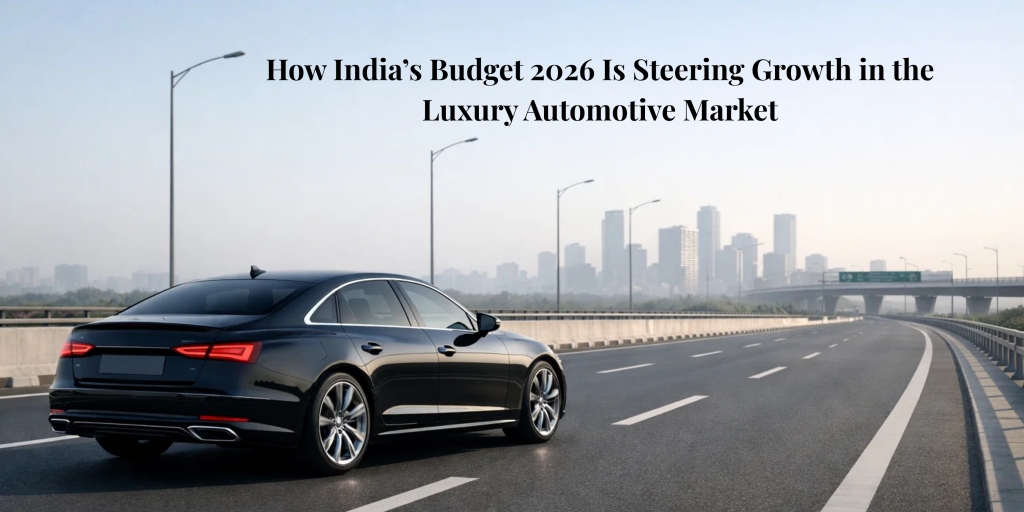
India’s Budget 2026–27 has delivered a multi-layered strategy aimed at accelerating the auto industry’s transformation, from electrification to global competitiveness. While most headlines have emphasized electric vehicles and supply-chain localization, luxury automotive stakeholders, including premium OEMs, affluent buyers, and high-end suppliers, are poised to benefit from key policy shifts.
In this blog, we break down what the Budget means specifically for the luxury segment, how it affects pricing and demand, and why this could be a pivotal year for premium cars in India.

-
Luxury Cars Get a Boost Through Macro Automotive Reforms
While the Budget largely focuses on manufacturing and components, a record infrastructure push and industry reforms indirectly benefit the luxury car market.
- Record Capital Expenditure: The government has raised the capital expenditure target to 12.2 lakh crore for FY 2026–27, representing 4.4% of the GDP. This sustained focus on high-speed rail corridors, 20 new national waterways, and expanded highway networks makes luxury vehicle ownership more attractive by improving the long-distance driving experience.
- Improved Logistics Networks: The development of a new dedicated freight corridor linking Dankuni in the east to Surat in the west will lower supply-chain costs for OEMs and reduce delivery times for imported luxury vehicles.
- Regional Growth Hubs: Allocation for infrastructure in cities with populations above five lakh (Tier-2 and Tier-3 centers) creates new wealth pockets and demand for luxury automobiles outside of traditional metro markets.
-
Tax Rationalization and Luxury Vehicle Pricing Dynamics
One of the most impactful changes affecting premium buyers is the implementation of GST Reform 2.0, which has streamlined the tax structure.
- New GST Regime for Luxury Cars: Following the 56th GST Council meeting and Budget 2026 updates, luxury cars and SUVs now fall under a flat 40% GST slab. This change includes the abolition of the Compensation Cess, which previously varied between 15% and 22%.
- Impact on On-Road Prices: Previously, the combined tax burden (28% GST plus cess) often exceeded 50%. Under the new flat 40% rate, the effective tax burden on large luxury SUVs and high-capacity sedans has actually been reduced, leading to more predictable and often lower on-road prices.
- Simplified Compliance: For premium OEMs, the removal of cess confusion eliminates classification disputes and simplifies the pricing architecture across different engine capacities and vehicle lengths.
-
Import Tariff Changes and Free Trade Agreements
The timing of Budget 2026 aligns with major trade milestones, specifically the finalization of the India-EU Free Trade Agreement in late January 2026.
- Phased Duty Reductions: Under the new agreement, import duties on European vehicles (CBUs) are set to be slashed from the current 70–110% down to an eventual 10% over a phased period.
- Quota-Based Access: Initially, this reduction will apply to a specified quota of 250,000 vehicles annually, specifically targeting high-value models from brands like Mercedes-Benz, BMW, and Audi.
- Market Expansion: While over 90% of luxury cars in India are currently locally assembled (CKD), the FTA allows manufacturers to introduce niche, high-performance models at more competitive price points, testing the waters for future local assembly.
-
Electrification and Luxury EV Momentum
Budget 2026 places a clear emphasis on battery cost reduction and supply chain localization, which is critical for the luxury EV segment.
- Customs Duty Exemptions: The Budget extended the Basic Customs Duty (BCD) exemption on capital goods used for manufacturing lithium-ion cells until March 2028. This directly lowers the input costs for premium electric SUVs and sedans.
- Critical Mineral Security: The creation of four rare-earth mineral corridors and duty exemptions on minerals like lithium and cobalt will support the domestic production of high-performance electric motors.
- Semiconductor Mission 2.0: With an enhanced outlay of 40,000 crore for electronic components, luxury OEMs can better source the sophisticated chips required for advanced driver-assistance systems (ADAS) and high-end infotainment clusters locally.
-
What This Means for Buyers, OEMs, and Suppliers
The 2026 fiscal roadmap creates a distinct set of advantages for every player in the luxury value chain.
Luxury Car Buyers
- More predictable pricing due to the unified 40% GST rate and the end of the Compensation Cess.
- Improved cost of ownership for EVs, which retain a low 5% GST rate.
- Enhanced resale value and utility as national highway connectivity reaches world-class standards.
OEMs and Luxury Brands
- Opportunity to expand market share by leveraging India’s growing semiconductor and component ecosystem.
- Ability to introduce global flagship models more easily under the new India-EU FTA quotas.
- Better fiscal stability with the Minimum Alternate Tax (MAT) reduced to 14% and becoming a final tax.
Suppliers and Tier-2 Partners
- Access to the 10,000 crore SME Growth Fund to help component makers upgrade technology for premium requirements.
- Reduced working capital blockage through the streamlining of GST refunds for inverted duty structures.
Also Read: How India’s Budget 2026 Could Rev Up the Luxury Auto Industry
Conclusion: Luxury Automotive Outlook Brightens Post-Budget 2026
India’s Budget 2026 sets the stage for robust growth in the luxury automotive segment by strengthening the fundamentals of infrastructure, tax transparency, and manufacturing depth. By shifting from temporary subsidies to structural reforms, the government has created a stable environment where premium performance and sustainable mobility can thrive together. For those looking to enter the luxury market or expand their fleet, 2026 stands as a landmark year where policy and aspiration finally align.
To stay ahead of the curve in India’s rapidly evolving automotive landscape, follow Motozite for the latest expert analysis, luxury trends, and comprehensive vehicle comparisons. We are dedicated to providing you with the insights you need to navigate the premium market with confidence.