
Introduction
The India-EU Free Trade Agreement (FTA), one of the most significant trade deals in decades, was officially concluded on January 27, 2026. After nearly 20 years of negotiations, this landmark pact is set to redefine the trade relationship between India and the European Union by reducing or eliminating tariffs on a vast range of goods. For Indian automotive enthusiasts and luxury car buyers, the focus is squarely on how this deal will impact European brands, particularly Mercedes-Benz. While the agreement promises a sharp reduction in import duties, the reality of how and when these savings reach consumers is more nuanced than the headlines suggest.
In this article, we break down:
- Which Mercedes models are affected by the new tariff structure
- The specific changes in import duties and the quota system
- Realistic pricing shifts and timelines for implementation
- Why immediate price drops are unlikely for most buyers
- Long-term implications for the Indian luxury car market
What the India-EU FTA Changes for Car Imports

Under the newly finalized FTA, the prohibitive tariffs on European cars imported as Completely Built Units (CBUs) are scheduled for a phased reduction.
- Tariff Reduction: Current duties, which peak at 110% for vehicles with a CIF (Cost, Insurance, and Freight) value above $40,000, will be lowered. Initial cuts are expected to bring duties down to approximately 40% in the first phase, eventually reaching 10% over a 5-to-10-year period.
- The Quota System: These preferential duties are not unlimited. They apply to a Tariff Rate Quota (TRQ) of 250,000 vehicles annually. Within this quota, specific allocations are made based on price brackets, ensuring a balanced influx of vehicles across different luxury segments.
- Threshold for Benefits: To protect domestic mass-market manufacturing, only vehicles with a CIF value exceeding €15,000 (approximately ₹13.5 lakh) qualify for these concessions.
- Electric Vehicles (EVs): In a strategic move to safeguard the domestic “Make in India” EV ecosystem, tariff cuts for electric vehicles have been deferred. Concessions for EVs will only begin after five years of the agreement being in force.
- Implementation Timeline: While negotiations have concluded, the agreement requires legal ratification. The first phase of duty reductions is expected to take effect between late 2026 and early 2027.
How Mercedes-Benz India Operations Impact Pricing
To understand why the FTA affects some Mercedes models more than others, it is essential to distinguish between the two primary ways these cars enter the Indian market.
CBU (Completely Built Units) Imports
These are vehicles fully assembled in Europe and shipped to India. They currently attract the highest duties (70% to 110%) and are the primary beneficiaries of the FTA.
CKD (Completely Knocked Down) Local Assembly
Over 90% of Mercedes-Benz India’s sales volume consists of models assembled locally at its Chakan plant in Pune. These kits already attract a significantly lower duty of approximately 15% to 16.5%. Because these taxes are already low, the FTA will have a minimal impact on the pricing of locally produced models.
Mercedes Models Likely to Benefit from the FTA

Models imported as CBUs, typically niche or high-performance vehicles, will see the most significant cost reductions as tariffs drop from 110% toward the 10% target.
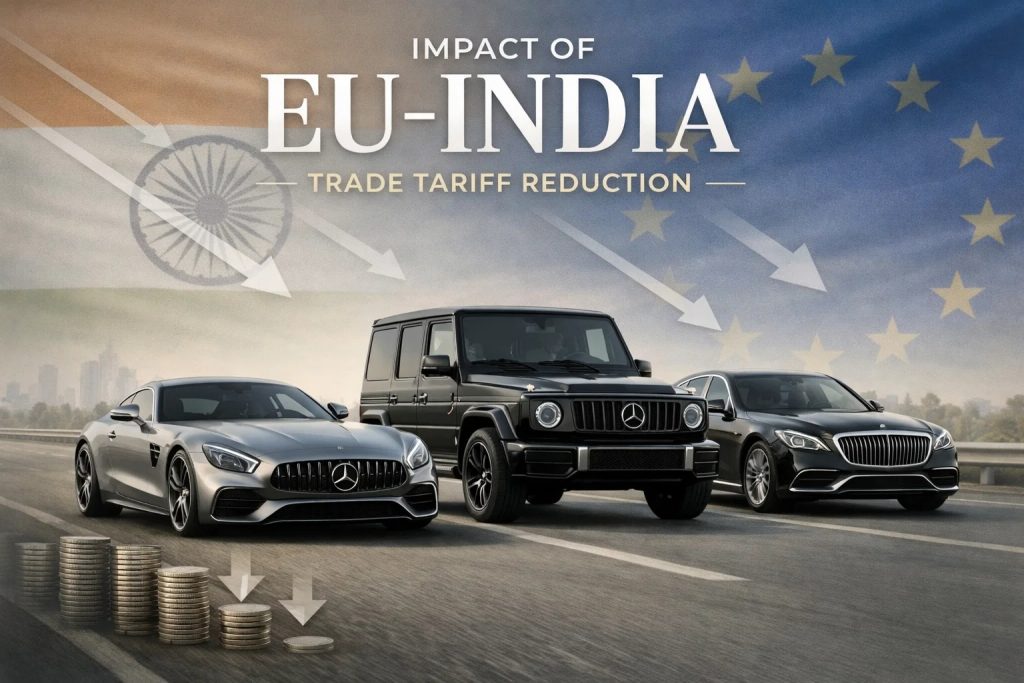
- Mercedes-AMG Performance Range: This includes icons like the AMG GT, C 63, and other high-performance variants.
- Top-End Luxury Icons: The Mercedes-Benz G-Class (G-Wagon) and the Maybach SL 680 are primary candidates for significant price shifts.
- Niche Lifestyle Models: Vehicles like the CLE Coupe and the upcoming 2026 GLB (expected as a CBU) will likely see more competitive pricing under the new regime.
Also Read : How Mercedes-Benz India Sees FTAs Driving Luxury Car Demand
Mercedes Models Unlikely to See Immediate Price Changes

Because the majority of the Mercedes-Benz lineup in India is manufactured locally, the FTA will not cause a price drop for the following high-volume models:
- Sedans: A-Class, C-Class, E-Class, and the locally produced S-Class.
- SUVs: GLA, GLC, GLE, and GLS.
- Electric Models: The EQE, EQS, and the upcoming CLA EV will not see duty-linked price cuts for at least five years.
- Select Maybach Models: The Maybach GLS is now locally produced in India, making it ineligible for CBU tariff concessions.
Projected Pricing Roadmap: Now vs. Post-FTA
While final showroom prices depend on GST, cess, and dealer margins, the reduction in Basic Customs Duty (BCD) will lower the base price upon which other taxes are calculated.
|
Category |
Current Duty | FTA Initial Phase (Est.) | FTA Final Target (10 Years) |
|
High-end CBU (> $40k) |
110% | 40% | 10% |
|
Mid-range CBU (< $40k) |
70% | 30% |
10% |
| Local CKD Assembly | 16.5% | No Change |
No Change |
| Electric Vehicles (EV) | 70% to 110% | No Change (Years 1-5) |
Gradual reduction after Year 5 |
Why Price Drops May Be Muted
Mercedes-Benz India leadership has cautioned that several factors may offset the benefits of lower tariffs:
- Currency Volatility: The Indian Rupee has seen significant depreciation against the Euro (approximately 19% in 2025). This depreciation can effectively cancel out any savings gained from lower import duties.
- Input Costs: Rising global manufacturing and logistics costs have led to annual price hikes across the luxury segment, including a 2% increase by Mercedes-Benz in January 2026.
- Phased Rollout: The transition to a 10% duty is a decade-long roadmap. Buyers expecting a “half-price” Mercedes in 2026 will likely be disappointed, as the most substantial cuts are years away.
Also Read: Will FTAs Really Make Luxury Cars Cheaper in India?
What This Means for the Indian Luxury Buyer
- Greater Variety: The FTA makes it more viable for Mercedes to introduce niche European models to India without the burden of prohibitive taxes, offering buyers more choice in the performance and ultra-luxury segments.
- Investment in Local Tech: As part of the broader deal, the removal of duties on auto components over 5 to 10 years will help lower the long-term costs of local assembly and encourage the transfer of advanced automotive technologies to India.
- Strategic Purchasing: Buyers interested in high-end CBUs like the G-Wagon or AMG models may benefit from waiting for the first phase of implementation in late 2026, while those looking for volume models like the E-Class should focus on current market offers and local production value.
The India-EU FTA is a historic step that signals a more open and competitive future for the Indian automotive market. While the “Made in India” models that form the backbone of Mercedes-Benz’s success will remain steady in pricing, the door is now open for a new era of affordable high-performance luxury.
The landscape of the Indian luxury car market is shifting rapidly, and staying informed is the best way to make a smart investment in your next vehicle. At Motozite, we are dedicated to bringing you the most accurate, data-driven analysis of how global trade policies and industry trends impact your driving experience. Follow Motozite for the latest updates on luxury car launches, expert price comparisons, and deep dives into the future of automotive excellence in India.
