
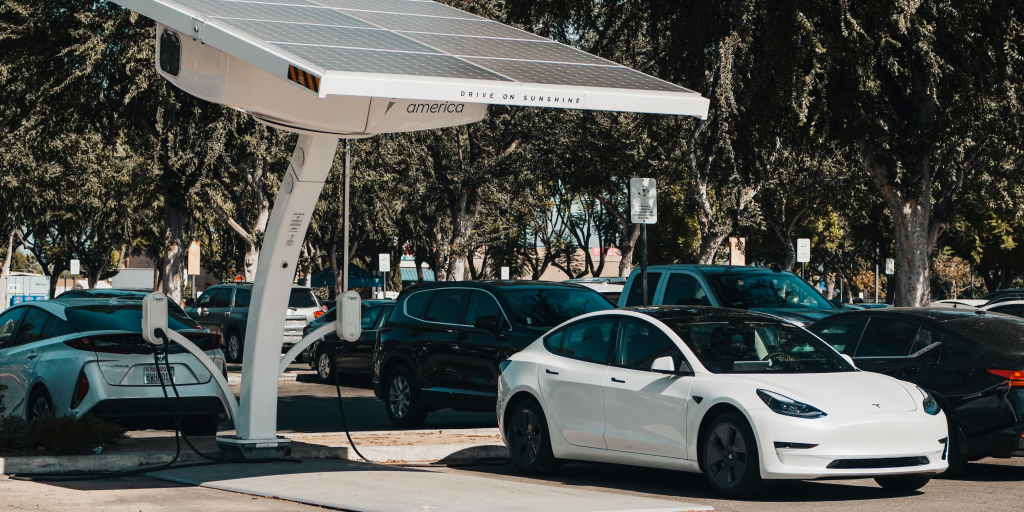
Introduction: Electric Cars Are Older Than You Think
Electric cars are often portrayed as a 21st-century innovation, yet their story begins nearly 200 years ago. Long before gasoline engines dominated the roads, electric vehicles were quiet, clean, and technologically superior for urban life. Understanding the history of the electric car is essential to appreciate modern innovation and to understand why EVs faced a temporary decline before their current global success. This is a story of invention, disappearance, rediscovery, and eventual inevitability.
-
The Birth of the Electric Car (1830 to 1890)
The foundations of electric mobility were laid by several independent inventors across Europe and America.

- The 1830s: Inventors in Scotland, Hungary, and the Netherlands built the first crude electric carriages. Robert Anderson of Scotland is often credited with developing the first electric carriage between 1832 and 1839.
- 1835: Professor Sibrandus Stratingh of Groningen, the Netherlands, developed a small-scale electric vehicle powered by non-rechargeable primary cells.
- 1859: French physicist Gaston Planté invented the first rechargeable lead-acid battery, making electric vehicles a practical possibility for the first time.
- 1881: Camille Alphonse Faure significantly improved the lead-acid battery design, increasing its capacity and paving the way for industrial production.
- 1884: Thomas Parker built the first production electric car in London using his own high-capacity rechargeable batteries.
-
Electric Cars in the Early Automotive Era (1900 to 1920)
By the turn of the 20th century, electric vehicles (EVs) had reached a peak in popularity, especially in urban areas.
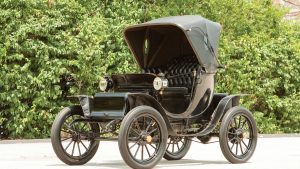
- Market Dominance: In 1900, electric cars accounted for approximately one-third of all vehicles on the road in the United States, often outselling both steam and gasoline counterparts.
- The Preferred Choice: EVs were favored because they did not require the difficult hand-cranking used in early gas cars, they operated quietly, and they produced no smelly exhaust fumes.
- Notable Early Makers: Companies like Baker Electric and Detroit Electric became household names. Even Clara Ford, the wife of Henry Ford, famously preferred her Detroit Electric over the gasoline-powered Model T.
-
The Decline of Electric Cars (1920 to 1970)
Despite their early success, three major forces led to the near-extinction of electric vehicles by the mid-1930s.
- The Model T and Mass Production: Henry Ford’s assembly line made gasoline cars significantly cheaper. By 1912, a gasoline car cost 650 dollars, while an electric roadster sold for 1,750 dollars.
- The Electric Starter: Invented by Charles Kettering in 1912, the electric starter eliminated the need for a hand crank, removing one of the primary advantages of EVs.
- Cheap Fuel and Infrastructure: The discovery of large oil reserves in Texas made gasoline affordable, and the expansion of the highway system required a longer driving range than the batteries of the time could provide.
4. First Revival Attempts (1970 to 1990)
- Oil Crises: The oil shocks of 1973 and 1979 caused gas prices to skyrocket, leading governments and automakers to explore EV prototypes like the Citicar and the Enfield 8000.
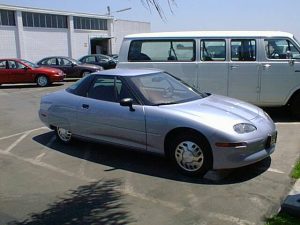
- The GM EV1 (1996): General Motors released the EV1, the first modern mass-produced EV from a major automaker. While it gained a cult following, GM famously discontinued the program in 1999 and reclaimed the vehicles, citing high costs and lack of profitability.
-
The Modern Electric Car Revolution (2000 to 2015)
The breakthrough that changed everything was the transition to lithium-ion battery technology.
- Tesla Impact: In 2008, Tesla Motors released the Roadster. It was the first highway-legal serial production car to use lithium-ion cells and the first to achieve a range of over 320 kilometers on a single charge.
- Public Perception: Tesla proved that electric cars could be fast, luxury-oriented, and desirable, rather than just utilitarian “commuter boxes.”
- The Nissan Leaf: Launched in late 2010, the Leaf became the first modern, all-electric zero-emission family hatchback produced for the mass market by a major global manufacturer.
-
Electric Cars Go Mainstream (2016 to 2025)
The last decade has seen a rapid shift from niche adoption to global mainstream acceptance.
- Global Market Leaders: As of 2025, China has become the worlds largest EV market, with nearly half of its new passenger car sales being electric.
- Policy Shifts: Countries like Norway have led the world in adoption, with over 90 percent of new car sales being electric. Many nations have set firm deadlines to phase out internal combustion engines by 2030 or 2035.
- Legacy Electrification: Major manufacturers including Volkswagen, Ford, and General Motors have committed tens of billions of dollars to transition their entire fleets to electric power.
7. Present Day: The EV Landscape in 2026
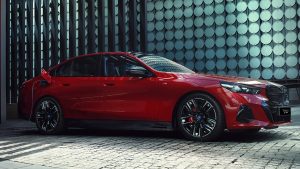
Today, the electric vehicle is the primary driver of automotive innovation.
EVICE Comparison 2026
|
Metric |
Electric Vehicle (EV) | Internal Combustion (ICE) |
|
Efficiency |
85 to 90 percent | 20 to 30 percent |
|
Maintenance |
Low (few moving parts) |
High (complex engine/fluids) |
| Tailpipe Emissions | Zero |
High |
| Energy Cost | Lower per kilometer |
Higher per kilometer |
8. The Future of Electric Cars

Looking ahead, the industry is focused on three major pillars of technology.
- Solid-State Batteries: Expected to enter mass production soon, these promise even higher energy density, faster charging times, and enhanced safety.
- Vehicle to Grid (V2G): This technology allows EVs to act as mobile batteries, feeding power back into the electrical grid during peak demand to stabilize energy systems.
- Sustainability: A shift toward closed-loop battery recycling ensures that materials like lithium, cobalt, and nickel are reused, reducing the environmental impact of mining.
-
Historical Milestones Timeline
- 1832 to 1839: First crude electric carriages developed.
- 1859: Invention of the rechargeable lead-acid battery.
- 1900: EVs reach their first peak in urban transport.
- 1912: Introduction of the electric starter for gas cars.
- 1996: Launch of the GM EV1.
- 2008: Tesla Roadster proves lithium-ion viability.
- 2025: Global EV sales exceed 15 million units annually.
Expert Context: Why This Time Is Different
Earlier attempts to revive the electric car failed due to high costs and lack of infrastructure. Today, those barriers have collapsed. Battery costs have dropped by over 80 percent in the last decade, charging networks have become ubiquitous, and government policy globally is aligned with a zero-emission future. History shows that when technology, economics, and policy align, the transition is irreversible.
Final Perspective
The journey of the electric car-from the experimental carriages of the 1830s to the high-performance machines of today-is a testament to the fact that great ideas never truly die. Electric cars did not fail in the past; they simply waited for the world to catch up to their potential. Now that the infrastructure and technology have finally arrived, the era of gasoline is coming to a close, and the circle of automotive history is complete.
Follow Motozite for more expert automotive insights, latest industry trends, and in-depth vehicle comparisons as we navigate the exciting future of mobility together.