
Luxury cars are not built to win “spec-sheet” wars. They are not defined by 0–60 mph times or peak horsepower figures, though they often possess both in abundance. Instead, they are engineered to reshape how time, distance, and effort are perceived by the human nervous system.
To the untrained eye, luxury looks like leather, chrome, or a high price tag. To those of us who have spent decades developing and validating these machines-from the hushed workshops of Crewe and Goodwood to the high-speed proving grounds of Ehra-Lessien-luxury is something far more elusive: it is the absolute absence of friction. This friction is not just mechanical; it is sensory and emotional.
This article dissects the true anatomy of a luxury car, not as a product, but as a philosophy.
1. Chassis & Platform Engineering: The Physics of “Calm”
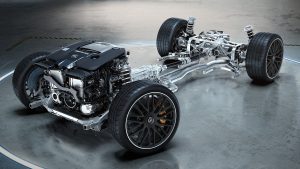
The chassis is the nervous system of a luxury car. If the foundational architecture is flawed, no amount of expensive hide or sound-deadening foam can compensate. In the world of high-end automotive engineering, we generally work with three distinct architectural philosophies:
Steel Monocoque: The Mass Damper
Traditional luxury sedans often utilize high-strength steel monocoques. While steel is heavier than aluminum or carbon fiber, weight is not always the enemy of luxury. Mass provides natural damping. A heavier chassis has higher inertia, meaning it is less prone to high-frequency vibrations from the road surface. This “heft” results in the classic, planted feel associated with long-wheelbase executive cars.
Aluminum Spaceframes: The “Architecture of Luxury”
Brands like Rolls-Royce and Audi (through the Audi Space Frame or ASF) pioneered the aluminum spaceframe. This involves a skeleton of extruded profiles and cast nodes.
- Torsional Rigidity: A modern luxury spaceframe often exceeds $40,000\text{ Nm/degree}$ of twist. This rigidity ensures that the suspension mounting points remain perfectly aligned, even under heavy lateral loads.
- Corrosion Resistance: For the collector, aluminum is a “forever” material, ensuring the vehicle’s structural integrity remains intact for decades.
Carbon-Intensive Architectures
In the “Hyper-Luxury” segment-think Bugatti or the Ferrari Daytona SP3-carbon fiber monocoques are the standard. Here, the engineering goal is structural precision. By using varying weaves of carbon fiber, engineers can tune the chassis to be stiff in one direction (for handling) while allowing microscopic “give” in another to soak up harsh impacts.
2. The Science of NVH: Curating the Sound of Silence
Noise, Vibration, and Harshness (NVH) engineering is where the battle for luxury is won or lost. In a standard car, engineers try to reduce noise. In a luxury car, we curate it.
Acoustic Lamination
Standard automotive glass is a single pane. Luxury glass is a “sandwich.” We use a specialized Polyvinyl Butyral (PVB) interlayer between two layers of glass. This interlayer is specifically tuned to target the 2,000 Hz to 6,000 Hz frequency range-the exact range where wind “whistle” occurs and where human hearing is most sensitive.
The “Anechoic” Challenge
Interestingly, you cannot make a car too quiet. Total silence in a moving vehicle causes sensory deprivation, leading to motion sickness. Luxury engineers therefore live in a “heartbeat”-a low-frequency, reassuring hum from the tires or engine that provides a sense of speed without the fatigue of “noise.”
Damping the Unseen
We utilize “Mastic” dampers-heavy, bitumen-based pads-applied to the large flat metal surfaces of the floor and doors. These shift the resonant frequency of the metal panels outside the range of human hearing. When you close the door of a Bentley and hear that “thud,” you aren’t hearing the latch; you are hearing the result of hundreds of hours of acoustic damping.
3. Powertrain: Authority Without Aggression
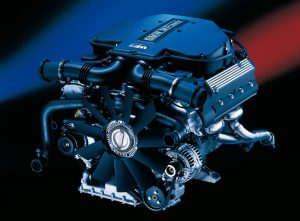
A luxury engine is a servant, not a performer. Whether it is a W12, a V12, or a high-output Electric Drive Unit (EDU), the calibration focuses on Linearity.
Throttle Mapping and “Tip-In”
In a sports car, the throttle is “short”-meaning a small foot movement results in a massive surge. In a luxury car, we engineer a “long” throttle. The first 20% of pedal travel is dedicated to smooth, imperceptible movement. This allows a chauffeur to pull away from a stoplight so smoothly that the passengers don’t feel the transition from static to kinetic.
The Rise of the Electric Luxury Drive
Electrification is the ultimate expression of luxury powertrain engineering.
- Zero Driveline Shock: There are no gear shifts, meaning no interruption in torque.
- Low-Speed Serenity: At speeds under 30 mph, an electric luxury car is virtually silent, allowing the “emotional bandwidth” of the passengers to be spent on conversation or thought rather than filtering out mechanical clatter.
4. Suspension: The “Magic Carpet” and Predictive Logic
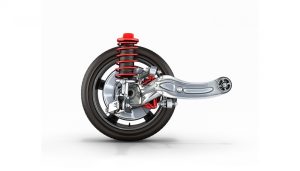
The goal of a luxury suspension is to keep the cabin perfectly level (the “skyhook” theory), regardless of what the wheels are doing.
The 48-Volt Revolution
Modern luxury cars use 48V electrical architectures to power Active Anti-Roll Bars. In a straight line, these bars are effectively “disconnected,” allowing each wheel to move independently over bumps without rocking the entire car. The moment the sensors detect a turn, electric motors twist the bars with thousands of Newton-meters of force to keep the car perfectly flat.
Proactive Damping
Using stereo cameras mounted behind the rearview mirror, the car “sees” the road. If the camera detects a speed bump 10meters ahead, the suspension computer pre-fills the air springs and softens the dampers just as the tire makes contact. The bump is not just managed; it is deleted.
5. Interior Craftsmanship: The Human-Machine Interface
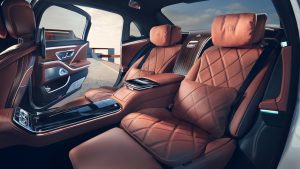
While robots build cars, only humans can build luxury.
The Selection of Hides
A luxury car interior can require up to 15 different hides. Engineers and craftsmen look for cattle raised in high-altitude regions (like the Bavarian Alps) where there are no barbed wire fences or biting insects that could scar the skin.
- Breathability: We avoid heavy top-coat paints on the leather, opting for “Aniline” or “Semi-Aniline” finishes that allow the natural pores of the leather to regulate temperature.
Wood and Metallurgical Feel
If a button looks like metal, it must be metal. The “thermal conductivity” of the material matters. When a passenger touches a vent, they should feel the initial coldness of the steel or aluminum, which then slowly warms to their touch. This is a “haptic” luxury that plastic can never replicate.
6. Ergonomics: Engineering for the Long-Term

A luxury car is not designed for a 15-minute test drive; it is designed for a 10-hour transcontinental journey.
The “H-Point” and Pressure Mapping
We use digital “manikins” and pressure-sensing mats to ensure that body weight is distributed evenly across the seat. In a standard car, “hot spots” of pressure develop on the tailbone after two hours. Luxury seats use multi-density foams-softer on the top layer for initial comfort, and firmer underneath for skeletal support.
Physicality vs. Digitalization
There is a growing trend of “Digital Restraint” in true luxury. While mass-market cars move every function to a touchscreen, luxury brands are returning to physical knurled-metal knobs. Why? Because muscle memory is luxury. Being able to adjust the volume or temperature without taking your eyes off the road-using a dial that provides a satisfying, mechanical “click”-is a superior ergonomic experience to digging through digital menus.
7. The Validation Phase: Proving Perfection
The “Engineering” of a luxury car doesn’t end when the CAD drawings are finished. It ends after millions of miles of torture testing.
- The Dust Test: Luxury cars are placed in “dust tunnels” where fine particulates are blasted at the car to ensure that even after ten years in a desert climate, no dust enters the cabin seals.
- The “Squeak and Rattle” Rig: The car is placed on a four-post shaker that simulates the roughest cobblestone roads in the world. Engineers use ultra-sensitive microphones to find even the tiniest “chirp” from a dashboard clip, which is then redesigned.
8. Brand Philosophies: The Specificity of Luxury
Luxury is not a monolith. Each brand engineers a different “flavor” of excellence:
- Rolls-Royce: Engineers “Effortlessness.” The steering is light, the car is silent, and the world is kept at a distance.
- Bentley: Engineers “Authority.” There is a muscularity to the steering and a controlled growl to the engine that suggests power held in reserve.
- Porsche: Engineers “Dialogue.” Every vibration felt through the seat is intentional, telling the driver exactly how much grip is left on the front tires.
Conclusion: The Investment in the Invisible
Why can luxury not be faked? Because luxury is the sum of a thousand “invisible” decisions. It is the decision to use a hydraulic bush instead of a rubber one; the decision to hand-match the grain of the wood across the dashboard; the decision to spend $10$ million developing a door hinge that closes with a specific acoustic signature.
A true luxury car does not try to impress you with gadgets that will be obsolete in three years. It impresses you with engineering integrity that will feel just as robust in thirty years. It is a reference point-a machine that doesn’t just transport you, but restores you.